厦大史学
主讲人
吉浦罗(Francois Gipouloux) ,法国国家科学研究院(CNRS)荣誉主任、法国社会科学高等研究院(EHESS)研究员。他先后求学于巴黎第七大学、北京语言学院(1975)、北京大学(1976-1977),1981年获得法国社会科学高等研究院博士学位。其主要研究领域是中国城市化的发展动态、13至19世纪欧洲和亚洲经济与商业的比较研究。曾发表过多部有关经济史、亚洲史等方面研究的专著以及相关学术论文,代表作为《亚洲的地中海》。吉浦罗研究员曾任法国驻华大使馆商务副参赞、外交部顾问,并主持法国国家科学研究院、国家研究署(ANR)和欧盟的多项重大科研项目。2017年被授予法国荣誉军团骑士勋章。
主持人
张侃 ,厦门大学历史与文化遗产学院教授、院长
与谈人
陈博翼 ,厦门大学历史与文化遗产学院教授
第一讲
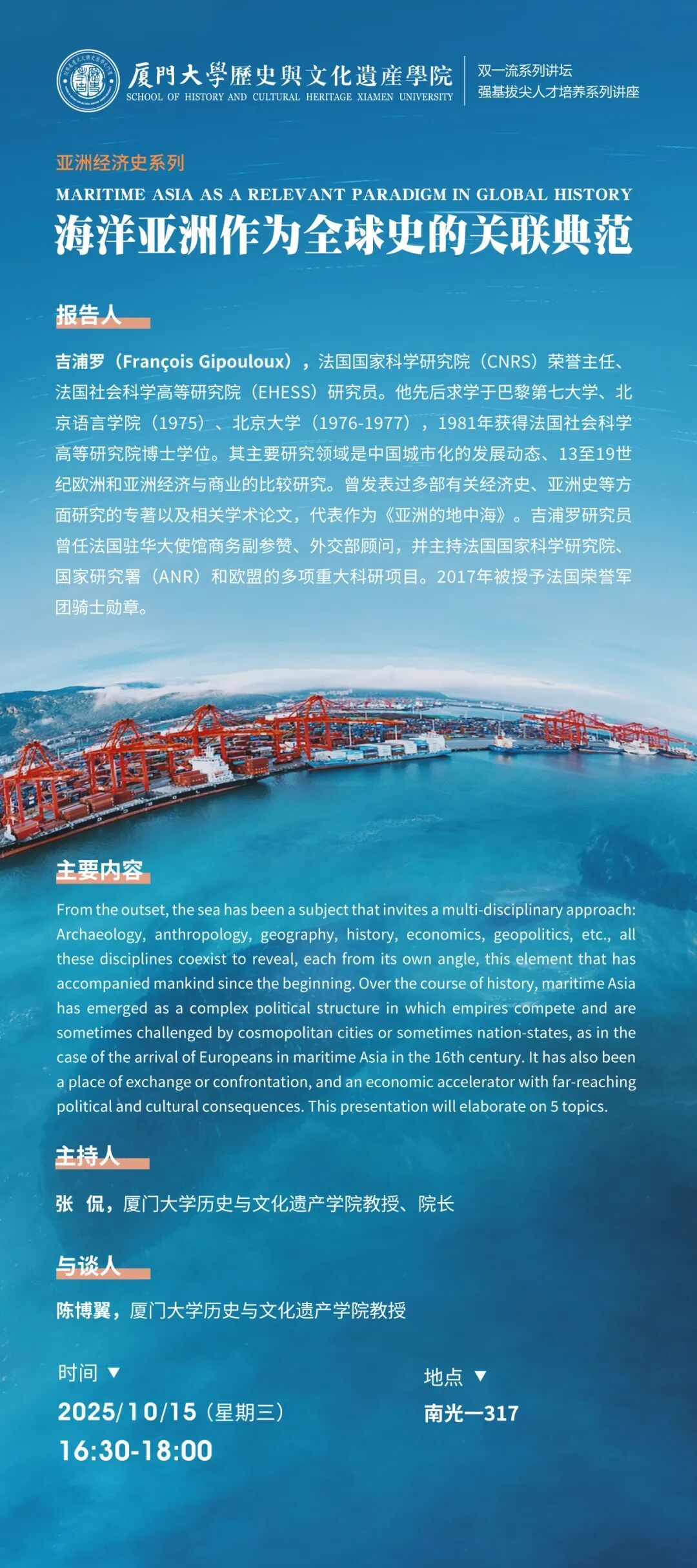
海洋亚洲作为全球史的关联典范
From the outset, the sea has been a subject that invites a multi-disciplinary approach: Archaeology, anthropology, geography, history, economics, geopolitics, etc., all these disciplines coexist to reveal, each from its own angle, this element that has accompanied mankind since the beginning. Over the course of history, maritime Asia has emerged as a complex political structure in which empires compete and are sometimes challenged by cosmopolitan cities or sometimes nation-states, as in the case of the arrival of Europeans in maritime Asia in the 16th century. It has also been a place of exchange or confrontation, and an economic accelerator with far-reaching political and cultural consequences. This presentation will elaborate on 5 topics.
主持人:张侃 教授、院长
与谈人:陈博翼 教授
时间:2025.10.15 16:30-18:00
地点:南光一317
协办:厦门大学海洋文明与战略发展研究中心
第二讲
制度创新、市场扩展与经济发展:
中世纪欧洲与明清中国的比较
A commercial revolution occurred twice in China's long history, under the Song in the 12th century first and then at the end of the Ming period in the mid-16th century. What were the factors that inhibited its transformation into an industrial revolution, like the one in Europe, or even an industrial revolution, like the one in Tokugawa Japan? We see rich merchants appearing in China during this period. But rich merchants and capitalist entrepreneurs are two different things. What mechanisms prevented the transmutation of savings into capital during the Ming and Qing periods? This presentation proposes another interpretation of the Europe/China divergence, based on a redefinition of capitalism in much broader terms than its mere reduction to the industrial revolution. To better understand the issue of divergence between China and Europe, this presentation will also draw on a comparison with key features of thirteen century Europe’s commercial revolution. As a historical construction, the market must therefore be considered as the result of a permanent dialectic between economic andpolitical power.
主持人:陈博翼 教授
与谈人:陈瑶 副教授
时间:2025.10.22 16:30-18:00
地点:南光一317
协办:厦门大学海洋文明与战略发展研究中心
第三讲
明清中国的风险管理与保险实践:
内陆、水路及海上运输
This presentation will examine how numerous loan contracts drawn in China's overseas trade in the 17th and the 18th century can be considered similar to rudimentary forms of marine insurance: the borrower would offset his lack of capital since the sum borrowed was usually only for a fraction of the cargo. This type of loan exposed the lender to the cargo value, and in the event of shipwreck or pirates attack) the lender would lose the sum and the interest it carried. Moreover, itinerant merchants' presence on board may suggest the necessity to protect their cargo against the risk of fraud or malpractice on the part of the captain or the crew. In late imperial China's maritime trade insurance was granted by government protection or by monopoly, or even by pirates whose protection could be sought in return for money.
In both cases, the merchant had to spend large sums to obtain this protection, or to enjoy the monopoly, which could only be granted by the political power. In the end, the transaction costs of achieving these results were higher than the cost of the insurance itself.
主持人:黄肖昱 助理教授
与谈人:伍伶飞 副教授
时间:2025.10.29 16:30-18:00
地点:南光一317
协办:厦门大学海洋文明与战略发展研究中心
第四讲
法律与商业惯例:
中世纪欧洲与明清中国的比较因素
The strong demographic expansion and the growing commercialization of the Chinese economy in the 16th-18th century also caused an increase of commercial disputes. Many of these relate to payment defaults. Great merchants generally entrust their goods to locally recruited peddlers or shopkeepers, with payment being made on a specific date. But travelling salesmen and shopkeepers often fail to pay on time, resulting in numerous disputes. A large number of disputes also relate to river transport: they concern non-compliance with the transport contract and in particular the overcharging of prices by boatmen, failure to meet delivery dates, etc. Mao Yilu 毛一鷺 work Yunjian yanlüe 雲間讞略 [A Brief Account of the Judgments Rendered in Songjiang], reports on cases concerning disputes that arose during river or canal transport in Jiangnan. They expose the complex relationships of the various commercial operators (great traders, shopkeepers, boatmen or private guards) with the local administration. The local government controlled transport by imposing spatial restrictions on the circulation of certain goods such as salt, grain or fabrics in Songjiang Prefecture at the end of the Ming Dynasty. Interestingly, the resolution of conflicts, including through court decisions, depended on a dual recognition: that of a code of moral values shared by the complainants and that of the legitimacy of the evolution of property rights and economic institutions.
主持人:黄肖昱 助理教授
与谈人:郑坤艳 助理教授
时间:2025.11.5 16:30-18:00
地点:南光一317
协办:厦门大学海洋文明与战略发展研究中心
第五讲
商人、走私者与海盗:海上贸易及其对帝制晚期中国经济发展的影响
From the 16th to the 18th century, the Yellow Sea and the South China Sea formed an immense maritime region that prospered outside the limits of imperial jurisdiction, and where several port cities (Nagasaki, Canton, Macao, Sakai, and later, Manila and Batavia) were to assert themselves as the real centres of accumulation of wealth and knowledge. The influence of this maritime space expanded or contracted according to the power or weakness of the merchant networks that criss-crossed it. Maritime trade during the late Ming was characterised by the intermingling of tributary trade, private trade and piracy. The establishment of the ban on maritime trade gave way to a scarcity of goods entering China and to a great profitability of smuggling activities. While the ban on maritime trade had a limited success in eliminating piracy, it opened the possibilities of huge profits to illegal trade. Fujian and Guangdong coasts offered many opportunities to smugglers. This presentation will trace the evolution of partnerships in maritime trade through the analysis of four lawsuits lodged against merchants who defied the ban on maritime activities to engage in trade with Japan and South East Asian countries. During the Ming and Qing periods, maritime trade was a very lucrative though high-risk and a capital-intensive business. Were the various forms taken by maritime trade ‘proto-companies', the Chinese equivalent of the partnerships that appeared in Europe in the late medieval period? How were ownership and management, commercial function and transportation differentiated? How were contractual obligations honoured?
主持人:郑坤艳 助理教授
与谈人:陈博翼 教授
时间:2025.11.12 16:30-18:00
地点:南光一317
协办:厦门大学海洋文明与战略发展研究中心
